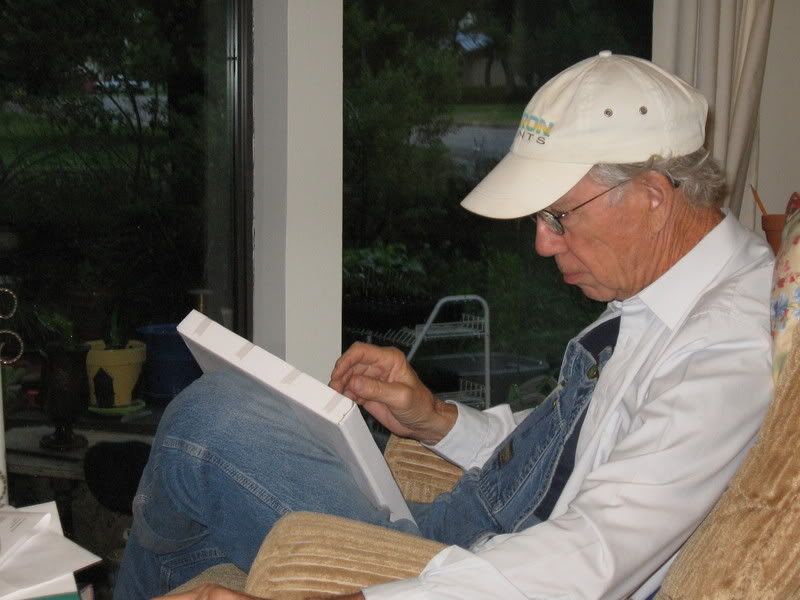
Sunday, May 29, 2011

Chapter One,...like an Octopus

Chapter One

Be Ye Not Mentally Lazy

You may have grown up, as I did, convinced that the authority figures in your world were telling the truth, at least to a degree. I sensed a core of truth in what they so dogmatically said, but I knew in my gut that at some points they were wrong. I recognized that, while maybe they were right, there was more to it than they let on, and often that "more to it" was what mattered most. I also knew that some people and the views they so strongly condemned were not as bad as they were made out to be.I knew that a lot of the wrongs they attacked were not always necessarily, totally wrong.Although at the time I could not have articulated it, I was developing a core of skepticism.

But I was well socialized, so never did I consider challenging any of this. They were bigger, older, smarter, richer, and they held the power to either punish or reward.There was no future in challenging their positions.


On the other hand I knew better than to trust my own mind. In school my classmates made better grades, were better athletes, better looking, and more popular. I was not a leader; no one ever followed or looked up to me. I was painfully aware of my own inadequacies, but although I was not fully conscious of it, I was also vaguely aware of the limitations of those in authority and even of my more popular and more gifted classmates.

I was nearly fifty-years-old before I realized the full implications of those childhood perceptions. Gradually I came to see that my tacit disagreement with society somehow comprised the elements of a more honest and complete approach to truth and life. The seeds of a new way of thinking had been planted; a way I much later came to call The DIALECTIC, the theme of this book.

After floundering through life for long years, I finally learned that it is easy to become a good thinker. Good thinking, however, is in short supply both because many of us are mentally lazy and because it requires something more than mere critical thinking, keen intellect, and formal education.

On the Other Hand

What it takes to become a good thinker is to make,"On the Other Hand," your habitual response to ideas, whether your own or those of others, spoken or written, in formal or in informal settings. No matter what is presented, always consider what might be "on the other hand," because no human statement is, by itself, ever complete, something is always left out, there is always more to be said, and it is always possible that what has been presented might be wrong. Develop a deep sense and appreciation of human limitations, determine to make "on the other hand" thinking second nature, and you are on the road to becoming a good thinker. Results will appear almost immediately. You will become a voice to be reckoned with.


Is that all there is to it? No, but if "on the other hand" thinking becomes a regular practice, you will quickly become a respected thinker. I remember from my youth that the Sears, Roebuck catalog offered a choice of merchandise at varying levels of quality: good, better, and best. You already have read enough to reach the genuinelygood level of thinker.

When you come to understand the larger dimensions of THE DIALECTIC--the proper name for "on the other hand thinking"--and when you add to that an elementary understanding of how logical thinking works, you will become a betterthinker.

And if you are still here when we come to the last pages of the book, we will consider how you can become the bestthinker that can be made out of your unique personality and place in the world.

Becoming a Thinker

Daddy was a workaholic and always gone, Mother was an old-fashioned housewife, a good one, busy doing all the work that entails, so I was pretty well left alone and by default became a lonely, lazy dreamer. I roamed the rivers, creeks, and hills, knowing I had been born fifty years too late to be the cowboy or mountain man that I read and dreamed of. I drifted mindlessly through the years until one day I found myself a high school graduate. I remember three graduation gifts, one of them in particular. Neither the creamy-yellow sport jacket nor the fancy corduroy shirt of many colors ever looked right on me, but somehow I have remembered them. More to the point was Mother's gift of a book of inspirational poetry and prose, Quests and Conquests. For years I enjoyed reading the book but was never inspired to actually do anything. The book didn=t change me, but Mother's inscription written in the front of the book, "Be ye not mentally lazy," haunted me.

Mother's admonition was based on accurate observation. I don't remember having ever thought much about anything for the first twenty years of my life, but when I read her inscription I knew immediately that I needed whatever it was that she was calling for. However, I neither knew what to do about it nor how. The problem was that I had no thinking equipment, skills, or coaching, and had no prior encouragement to think (few schools or homes teach us how to think).It would be long years before I made any progress in that direction, but Mother's words were never far from my consciousness; I felt their challenge continually.

Several years later, I found myself in a theological seminary studying to become a minister. There I heard professor Gordon Clinard declare that the greatest weakness of Southern Baptist preaching was shallowness.Immediately I vowed that my sermons would have depth. During seminary years, I worked, without adequate tools for thinking, at exploring the depths of God's word and of human experience. I was still depending on others, teachers and books, to do my thinking for me, and I still trusted them. Yet I knew they were missing it somewhere.

When I was given my first teaching position and found that I had to teach--and thus learn--logic, I discovered, finally, a method of systematic thinking.Logic, I came to realize, should be required of all high school graduates--not symbolic logic, but traditional, elementary logic.


Now, I was a beginning philosophy teacher and confident of my ability as a thinker. But I had a lot to learn. It took a half-dozen years of teaching philosophy before all of the above began to converge in the idea ofTHE DIALECTIC. I completely rewrote my philosophy courses, making the DIALECTIC central, and have taught it now for more than thirty years. Mother would be proud of her easy-going son because across the years, among faculty and students alike, I have gained a reputation for making people think.They tell me they now think about things they never thought about before, and from perspectives they would have never before considered. Let's talk about how you can improve your thinking ability and practice.

But on the Other Hand

The words of a Randy Travis song suggest the way. Early in his career Travis sang about a fellow who has just met an exciting woman. She has captivated his complete attention, has him almost spellbound. As he considers the possibility of spending the night with her, he sings, "On one hand I count the reasons I could stay with you . . . all night long . . . and on that hand I see no reason why it's wrong." That is one way for him to look at the situation. But the refrain reveals the rest of the picture, as he sings, "But on the other hand there's a golden band, to remind me of someone who would not understand." He has been tempted to forsake his marriage, and might have done so if he just looked at things from the most obvious point of view, the way he felt. He sings about a strong desire to stay, but the logic of marital love and commitment tells him that, "the reason I must go is on the other hand."


This indicates the importance of DIALECTICal thinking for even the most careless of us. On one hand--every day, throughout the day--we see things we believe to be right and that feel right at the time, but on the other hand there is always more to be considered. On one hand we are ready to act; on the other hand it is always possible that we might be wrong and regret what we did.

In life too much is at stake for our conduct to be decided by one-handed thinking. President Harry Truman once told his cabinet members that he wished they would find him a one-hand economist. He said that every economist that briefed him presented a good analysis of the economic situation, and advised an appropriate course of action. However, Truman complained, once they laid all this out, they would say: "But on the other hand . . . ," and proceed to build the case for a different analysis and course of action. He wanted someone who had the answer.

The truth is that no single way of looking at anything ever sees the whole picture. There is always more. Mortimer Adler made the strange claim that the greatest contribution Greek civilization ever made to our culture was the idea of men andde. These strange words are two little particles in the Greek language, commonly translated into English as on one hand/but on the other hand. When we think of Greek culture, sculpture, philosophy, and drama, we might wonder what Adler was thinking when he made such an audacious claim. Why would he say on the one hand/but on the other hand is the greatest contribution of the Greeks? Because it is a concise expression of that which this book is about, that which we call the DIALECTIC.


The DIALECTIC

The DIALECTIC will not make you a better person--that is a whole different issue--but it will make you a better thinker.It will keep you out of a lot of trouble. You will not be surprised easily or often. It will make it easier for you to understand and get along with other people. Others will begin to respect you and your ideas more than they have in the past. If you are a student, you will become a better learner, performing better in the classroom and making better grades, gaining broader understanding and deeper insight. If you are married, you will become a better and more appreciated spouse. If you are part of a team at work, you will become a better and more valuable team member.

If all this sounds as though the DIALECTIC is some kind of a magic pill or silver bullet, you are hearing it right. No matter who you are, what you are interested in, or what you do, it will fit you. It will apply directly to what you are about. All this, and it is easy to learn and put to use.

Think like an Octopus

"On the other hand." That's the silver bullet. That's all it takes to become a good thinker. It's that simple. But on the other hand, it helps to notice still another hand.


I was sitting at the breakfast table, reviewing plans for my first philosophy class of the day. I was thinking specifically about the dialectic. Then I remembered that I had a problem student in that class. I only had three problem students in thirty-some years of teaching. This was one of them. He was one of those back row, disruptive whisperers.I had spoken to him about it a couple of times, to no avail. He seemed to have a lack of respect for me. So I shifted my mind from preparation for class to preparation for dealing with this aggravation.

I spent two years in the army as basic training officer. I have experience in sounding tough, and I can make the appropriate face to go along with the speech.I=ve never used that style in teaching.However, that morning, I was considering it.On the other hand, I could quietly inform him that if the whispers did not cease, he would receive an "F" in the class. On the other hand, I wasn't sure that would be a fair course of action. In fact, he might dare me to try it (he was the kind to do that). On the other hand, I had to do something because he was disrupting the class. So, on the other hand . . . Wait a minute, how many other hands do I have?

On the other hand is the dialectical formula. It is the way. But on which other hand. Mentally, we have more than two hands. Our left hand has its own right and left hands, and they have theirs. We need to think on as many hands as possible. We need to learn to think like an octopus. An octopus can think "on the other hand" several times before he runs out of perspectives to consider.


The way to become a good thinker is to think like an octopus. Usually there are many hands to consider. Each hand has other hands itself. Don't forget the left hand. Like a construction supervisor, hire other hands if they are needed. Don't settle on an answer, conclusion, or idea until you have to because there are always these other hands to turn to.We will never have time to check them all out, but don't quit early, especially if there is much at stake.

Think dialectically, consider others, even your enemies, maybe especially your enemies, and think like an octopus thinking on all eight hands. However, if we seek to examine all hands, can we ever make a decision?

At some point we have to cut off thought and act on the best judgment we can make at the time, always realizing that what we do may turn out wrong. We have no choice, however, but to use our best judgment at the time, however incomplete it may be.


Saturday, January 22, 2011

Blog Termination?

I'm sure you've noticed months ago that I have stopped posting to this blog. The book I was in the process of blogging--Think Like an Octopus--has been published and is available from your book seller.

I may post occasionally to this blog as ideas of value come to me that are not covered in the book. i might not.

Monday, November 8, 2010

Chapter 7/11

Freedom and Determinism

Freedom and determinism? We need to understand this dialectic if we are to think clearly.

We are free to make choices. The range of our choices, however, is limited. Heredity and socio-cultural heritage limit our options. Every free choice we make determines a wide range of future options. Many decisions we make are irreversible; others can be reversed. So the development and character of life is determined by heritage, circumstances beyond our control, and personal decisions made within the limits imposed by heredity and environment–heritage, environment, and free choice.

We are and are becoming the embodiment of the dialectical interaction of these three factors. These are the elements that comprise the bipolar tension between determinism and freedom.

We are free to choose neither our genetic makeup nor our social heritage. My immediate heritage involves the Great Depression and World War II, rural southern Oklahoma, and small Baptist churches. My more distant heritage includes poverty-stricken, uneducated, Scotch-Irish farmers who fled Ireland’s Great Potato Famine and became Appalachian hillbillies. I had no more choice in any of this than I did of the genes that gave me a tall, slender frame, blue eyes, and an introverted personality.

If you were born in Vietnam in the 1960s, the daughter of a United States Marine and a Vietnamese mother who, before the war, had lived in a well-to-do home, your heritage would be quite different from mine. Perhaps now you live in Caldwell, Kansas where your husband has become a successful realtor, and you are an active member of the PTA. In your mind and heart you are still Buddhist.
Your thinking and mine will come from widely differing starting points. Although it is unlikely, it is possible that we might find common ground and come to similar conclusions for similar reasons. This could happen only after many dialectical considerations.

None of us choose our heritage, yet it is an inescapable element of our body, soul, and mindset. It provides the fundamental framework within which we find our personal options for making decisions.

Saturday, October 30, 2010

Chapter 7/10

Reason and Emotion

Another fundamental–essential–element of good thinking is the dialectical bipolar tension between reason and emotion. As in all true bipolar relations, neither of these, taken by itself, is valid. Good thinking exists only in the tension between the two. And there is no magic balance. Sometimes it is primarily emotion that powers good thinking; on other occasions reason rides in the driver’s seat. In either case, the other is consulted and taken seriously. Considerate thinking finds its place all along the spectrum between the two poles.

The movie, Guess Who’s Coming for Dinner? , draws its power from the tension of racism in conflict with love. Matt Drayton (Spencer Tracy) and Mr. Prentice (Roy Glenn) are convinced that their beloved children, “Joey” Drayton (Katharine Houghton) and Dr. John Prentice (Sidney Poitier) have lost their minds. The fathers are totally convinced that this interracial marriage would be a horrible mistake. They can think only of all the potential problems that would accrue were the marriage to take place. The situation comes to an impasse, until, finally, Mrs. Prentice (Beah Richards) confronts the two “old” men.

She speaks to their feelings, which she says have dried up long ago. She rebukes them for having forgotten what it is like to be young and deeply committed, as this young couple is. Her pain-laden challenge wakens Drayton’s heart and mind. Now he understands the situation as a whole, and in an impassioned speech, pours out the love and commitment to his wife that has not diminished across long years of marriage. The issue is resolved. The marriage receives the blessing of both parents.

Only as love’s emotion arises in antithesis to racism’s reason can any of them think clearly and thus see beyond their preconceived ways of thinking.

Thursday, October 21, 2010

Chapter 7/9

Aging

The morning I turned forty-five, before I even got out of bed, I decided that I was now “old enough.” All my life I had heard, “You’re not old enough . . .” to remember . . . , to do that, to wear that, to understand . . . , to enjoy. . .. On that day, February 15, 1979, I decreed that I was old enough for whatever.
But that notion begat another: I may be old enough, but I was not yet “old.” So, at forty-five I began to prepare for old age. I began studying gerontology. In succeeding years, I began carefully observing elderly people. I soon concluded that most people, if they live long enough, flunk old age. At least most that I have observed did not have a happy ending to their story.

People who had accumulated wealth and all that comes with it, or who had risen to prestigious positions of leadership, or who had the sophistication that accompanies world travel and education from elite universities–people such as these I have watched, and in large measure seen them end their years in the misery of emptiness. As a result, I began in earnest to study individuals who had earned good grades in aging. I knew my time would come, and I wanted to know the joy of a life fulfilled.

Now I am an old man in my seventies. What have I learned across the past thirty years? I’ve learned that the secret of successful aging lies in the bipolar dialectic of continuity and change, the every-changing, but necessary tension between thinking–and thus, living–like a conservative and like a progressive. Tradition and novelty.

Somewhere along the way I read and bought into the idea that the secret of successful aging was the ability to adapt. Those who can’t, or don’t, or won’t adapt are shunted off the road of life, into the ditch of bitterness. Yes, adaptability is essential. It is a necessary, but not sufficient condition for a good old age. The ability to adapt is one of those poles that is invalid when taken by itself. It makes its contribution to life, to old age, only as it lives in tension with the other pole: the commitment to hold onto those things that we have staked our lives on, believe in, and have integrated into our character.

On the other hand, necessary as it is to hold onto the best of the past, conservativism is insufficient to lead us to Browning’s “best [that] is yet to be, the last of life for which the first was made.” To adopt a purely conservative stance toward life is to become stagnant, then sour, then morose; it is a guarantor of misery.

It takes both. Some of us will need to maintain more continuity with the past, and keep more traditions, while others will need to venture more into the new cultures that continually emerge. But all of us must conserve that which we most value and believe in. All of us must adapt to some of the unavoidable novelty that seems so foreign to the world in which we spent most of our lives.
Myself, I hold to the matchless personal and social value of traditional marriage with its associated lifetime vows. In a world that increasingly distances itself from the natural, favoring rather the man-made modifications and replacements of nature, I am a determined conservative of the natural, the wild, and that which is essentially untouched, left in its apparently chaotic biodiversity. The blue bib overalls and western-style hats that are part of my rural Oklahoma heritage and that I still wear much of the time help give continuity to who I am.

On the other hand, I am on good terms with Gmail, blogging, Twitter, cell phones, and solar panels. I relate easily and comfortably with the generation of body piercings, tattoos, iPods, and MTV. They speak a different language, dress differently, and represent a culture completely foreign to what feels natural to me. But I made the choice back when I was forty-five that I would gradually become a naturalized citizen of this new nation, the nation of the younger, because, as is commonly said, I know that we are more alike than we are different.

It has not been easy to live feeling the strong pull from both poles. I have often lost my balance, often allowed myself to be pulled down, often failed to live the tension. Often I think I could relax and feel more comfortable if I allowed myself to completely polarize, but that would be to choose to lose so much that is vital.

Thursday, October 14, 2010

Chapter 7/8

Activity and Rest

A fundamental dialectic is the bipolar movement between activity and rest: day and night, six work days and a sabbath, break time during the work day, the growing seasons and winter, two hours of driving on the road followed by a rest stop, (federal law allows truckers thirteen hours on the road and mandates at least ten hours off duty before driving again, although many studies show this to be an inadequate rest period). If we stay only at one pole, we eventually burn out; if we stay too long at the other pole, we accomplish little or nothing. We need both rest and activity.

So it is with thinking. Think too long and your mind gives out. On the other hand, don’t quit too soon. I remember when our university bestowed an honorary doctorate on a wealthy south Texas farmer/business man. In his acceptance speech he said he often was asked the secret of his success. He told us it was just three words: “A little more.”

Thinking is work. In the early stages of becoming a considerate thinker, it can be hard work. The mind balks and says, “Leave me alone.” When this occurs, see if you can give it just “a little more.” Try to think of just one more “other hand” possibility, one more aspect of the antithesis, or another facet of either thesis or antithesis. Just one more try, then give it a rest.

The oak tree and the grape vine need winter’s dormant period so they can digest, stabilize, and incorporate the gains of the growing season. They need winter also for rest, restoration, and recovery. The birds of the air, the beasts of the field, the reader and writer–people like you and me–all need daily sleep. Some of us get by on a little less, others of us seem to require a bit more, but we slight our sleep only at great risk.

When the mind tires of cerebration, it calls us to move, for a while, toward the other pole: mindlessness. Myself, I check CNN online for a news update, get a snack from the kitchen, play a card game with my wife, go outside and enjoy the wide diversity of my native plant yarden, or watch my little flock of bantam chickens. It might be a good time to go shopping, visiting, or to bed and sleep. Do just about anything, but give thinking a rest.

I spoke of thinking as hard work, particularly as we begin deliberately to think according to the dictates of the dialectic. The “a little more” stretches the mind, even as a little more stretches our physical muscles. Just as we grow stronger lifting weights, gradually increasing the weight, so our minds grow stronger as we gradually demand more of them.

Think, think a little more, retreat, rest, allow time and space for re-creation. Cognitive ability will grow. Some of us will require more, some less mental rest and restoration. Give yourself whatever time is required to enable you to come back with readiness and enthusiasm. The time will come when thinking is no more tiring than walking or talking. The dialectic calls for some kind of rhythmic movement between activity and rest. Think about it.

Thursday, October 7, 2010

Chapter 7/7

We polarize for two or three reasons. When we take a polar position on anything, it gives us a sense of security. Polar positions are absolute. They leave us with no questions. A correlative of this is that we polarize because at the polar position we do not have to think. And, as always, it is easier to follow our comfortable crowd. Security, with no need to do the work of thinking, and plenty of company.

But the power of a magnet lies in neither its positive nor its negative pole. Rather the power resides in the tension between them. Were we to decide against negatives and make it all positive, or vice versa, we would be left with a piece of mere metal.

We are called on, regularly, to pick a pole: conservative or liberal, pro-life or pro-choice, freedom or determinism, capitalism or communism, socialism or individualism. “Which are you,” we are asked? Every time we adopt a polar position, something is destroyed, something vital. Reality, life, and truth exist in those polar tensions.

If we insist on the supremacy of individual rights and reject the claims of society, our thinking is invalid. If we claim that individual rights must be subordinated to the needs of society, our thinking is invalid. Neither pole, taken alone, is ever right. Only with the support of a healthy society can an individual attain her full potential; only when composed of a diverse body of well-developed individuals can a society maintain its health. The bipolarities of life are true, they are right but only in relation to each other, only as the tension is acknowledged.

Nor should we look for truth in a middle-of-the-road balance. Reality, life, and truth exist along an unceasingly shifting, fine line somewhere between the poles. Think of the tightrope walker with her balancing pole. It is rarely held perfectly horizontal. Sometimes it is tipped a little to the left or right, and sometimes it is tipped rather deeply one direction or the other, whatever is needed for the walker to maintain her balance. At times we see the pole tilted rapidly back and forth, from one side to the other.